Introduction
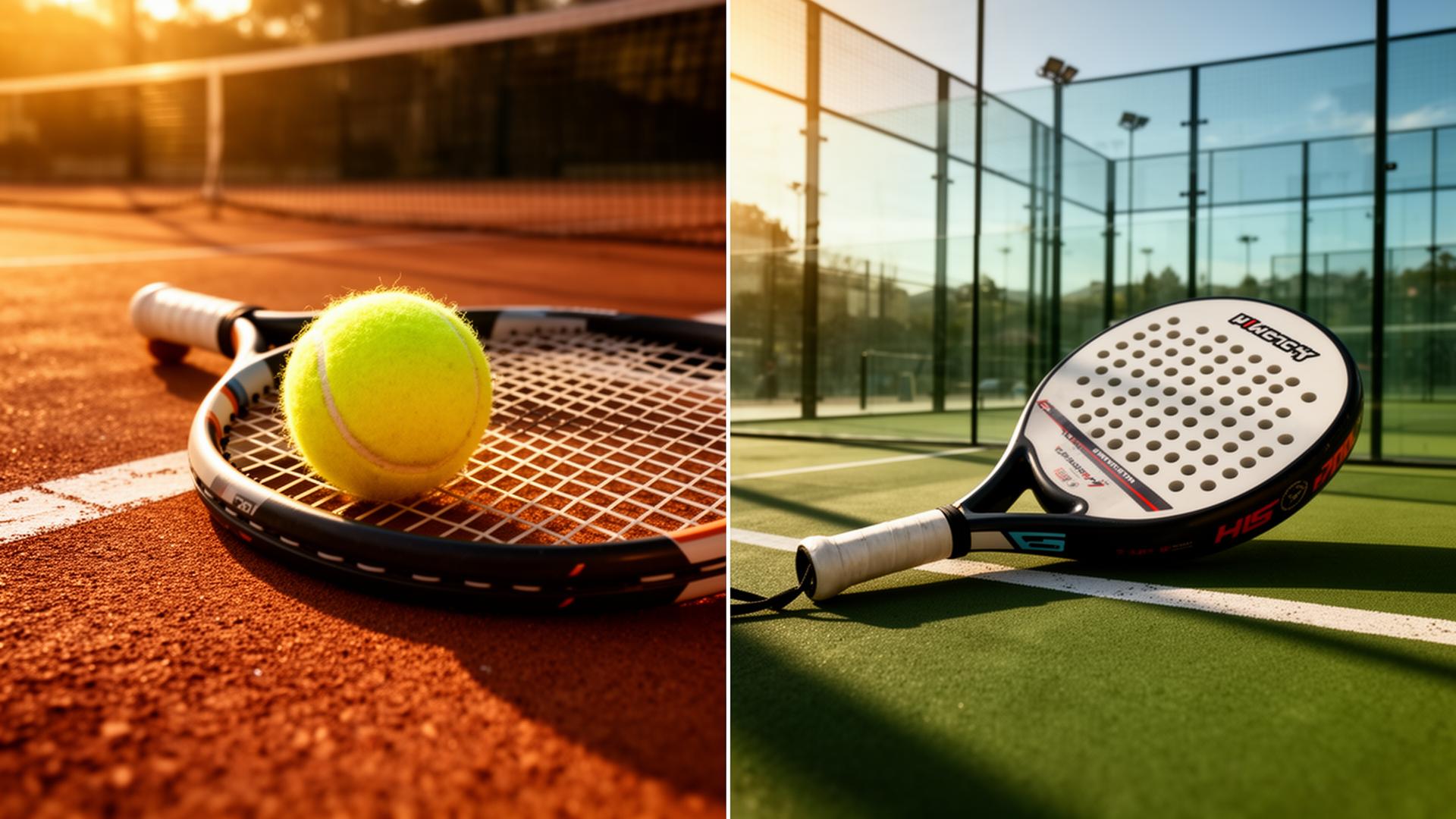
Tennis and padel are the two most talked-about racket sports in the world right now. They look similar at first glance — a net, a court, rackets, a yellow ball — but on the court they feel like completely different games.
If you are a tennis player curious about padel, or a padel player wondering how the two compare, this guide breaks down every key difference: court, rackets, scoring, walls, strategy, fitness, and learning curve.
1. The Court
Tennis Court
A tennis court measures roughly 23.77 m long and 8.23 m wide for singles (10.97 m for doubles). It is open on all sides — once the ball leaves the lines, the point is over.
Padel Court
A padel court is much smaller — 20 m long and 10 m wide — and fully enclosed by glass walls and metal mesh. The walls are part of the game, which completely changes how points are played.
2. The Racket
Tennis rackets are large, strung with synthetic gut or polyester, and rely on string tension to generate spin and power.
Padel rackets are solid (no strings), made from EVA foam cores with fiberglass or carbon faces, perforated with small holes. They are shorter and more compact for fast reactions at the net.
3. The Ball
Both sports use a similar-looking yellow felt ball, but padel balls have slightly lower internal pressure. This makes the bounce a bit softer and slower — perfect for the smaller court and wall play.
4. Singles vs Doubles
Tennis is played both as singles and doubles at every level. Padel is almost always played as doubles — singles padel exists but is rare and uses a narrower court. The doubles-first nature of padel is one of the reasons it is so social.
5. The Walls Change Everything
In padel, after the ball bounces on the floor it can be played off the back or side walls — just like squash. This means almost no ball is unreachable, rallies last longer, and tactics revolve around angles, lobs, and smashes that rebound off the glass.
In tennis, there are no walls. Power, depth, and movement decide every point.
6. The Serve
Tennis serves are overhead, fast, and one of the most decisive shots in the game — aces and unreturnable serves are common.
Padel serves are underhand, must bounce first, and are designed to start the point — not end it. This is a big reason padel is so accessible to beginners.
7. Scoring
Both sports use the same scoring system: 15, 30, 40, game, set, match. Most padel matches are best of 3 sets. The familiar scoring makes it very easy for tennis players to pick up padel quickly.
8. Difficulty and Learning Curve
Tennis has a steep learning curve. Beginners often struggle for months before they can rally consistently.
Padel is famously beginner-friendly. Most new players are rallying and enjoying real points within their first session. This single fact explains a huge part of padel's explosive global growth.
9. Physical Demands
Tennis demands more raw power, longer sprints, and bigger swings — it is harder on the shoulder and lower back.
Padel is more about quick reactions, short sprints, agility, and touch. It is generally lower-impact, which is why so many former tennis players, and players of all ages, transition to padel.
10. Strategy and Style
Tennis rewards aggression from the baseline, powerful serves, and big groundstrokes.
Padel rewards patience, positioning, teamwork, and clever use of the walls. The best padel players control the net, lob smart, and out-think opponents rather than out-hit them.
11. Social and Lifestyle Factor
Padel has become as much a lifestyle as a sport. Doubles format, shorter matches (around 90 minutes), and a relaxed club atmosphere make it ideal for meeting people and playing several times a week.
Tennis remains more individual and intense — equally rewarding, but with a different social rhythm.
12. Which One Should You Choose?
- Choose tennis if you love powerful, individual sports with a long technical journey.
- Choose padel if you want a fun, social, easy-to-learn sport you can enjoy from day one.
- Play both — many players in Dubai and around the world now do exactly that. The skills transfer beautifully.
Final Thoughts
Tennis and padel are not rivals — they are cousins. Tennis built the foundation of modern racket sports; padel is rewriting how millions of people experience that world today.
If you have never tried padel, do it once. One session is usually all it takes.
Article Information
Title: Tennis vs Padel — Key Differences Every Player Should Know
Written By: Hamidreza Sarbazi
Published Date: May 26, 2026
Location: Dubai
Category: Padel | Tennis | Racket Sports | Comparison
Hashtags
#Padel #Tennis #PadelVsTennis #TennisVsPadel #PadelDubai #PadelLife #RacketSports #PadelCoach #PadelAcademy #PlayPadel #PadelWorld #HamidrezaSarbazi
SEO Keywords
Tennis vs Padel, Padel vs Tennis, Difference between tennis and padel, Is padel easier than tennis, Padel rules vs tennis rules, Padel court vs tennis court, Padel racket vs tennis racket, Padel for tennis players, Padel Dubai, Best racket sport, Racket sports comparison