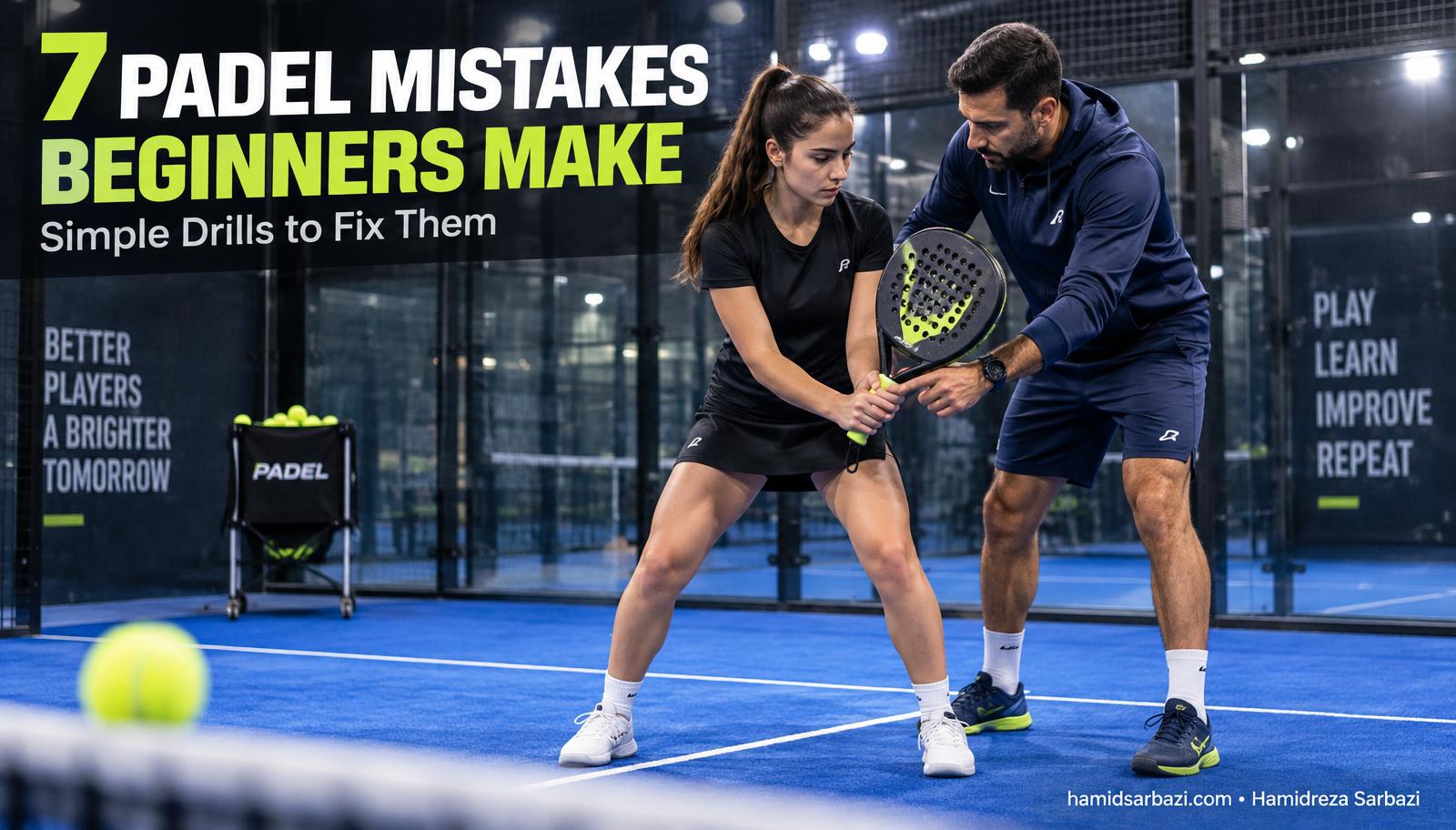
7 Padel Mistakes Beginners Make (and Simple Drills to Fix Them)
By Hamidreza Sarbazi | Padel coaching in Dubai | Updated October 20, 2026
Padel is welcoming to new players, but early rallies can encourage habits that hold your game back. The good news: you do not need a spectacular smash to improve. A few better decisions—where to stand, when to wait, and how to coordinate with your partner—can make your next match more controlled.
Quick answer: The most useful beginner corrections are to reduce unnecessary power, avoid getting stuck in the middle of the court, learn to read rebounds off the back glass, move with your partner, prepare early, choose sensible shots and recover your position after every ball. Try the seven short drills below.
1. Hitting every ball too hard
The mistake: Swinging as if every ball must be a winner. Big swings often send the ball into the fence or give the opponent an easy rebound.
The fix: Shorten the backswing and prioritize a repeatable contact point. From the back of the court, choose height and depth; when attacking, focus on safe placement.
Try this drill: Rally cross-court for three minutes at a comfortable pace. Count consecutive balls that land inside the court. Aim to beat your previous streak—not to hit faster.
2. Living in the middle of the court
The mistake: Standing halfway between the baseline and the net while opponents are set to volley. This can leave you vulnerable to low balls at your feet and lobs behind you.
The fix: Recognize two main phases: defend with enough room to use the back glass, then advance together to take the net when you have an appropriate ball. Mid-court is usually a transition area, not a permanent home.
Try this drill: Start both players in defense. After playing a deep, controlled lob, move forward together if the opponents are pushed back. Freeze after each rally and check whether both partners finished in a sensible position.
3. Panicking when the ball reaches the glass
The mistake: Rushing backward or swinging before understanding how the ball will rebound.
The fix: Watch the ball after its first bounce, turn your shoulders, make space from the glass, and let the rebound come to a comfortable contact point. Remember: after a legal first bounce on your side, a ball can rebound off your own wall and remain playable.
Try this drill: Have a partner feed gentle balls that bounce and then reach the back glass. Let each rebound travel before returning it cross-court. Begin without speed; build up only when your timing is steady.
4. Moving independently of your partner
The mistake: One player charges forward while the other stays far back, leaving gaps in the middle and on the diagonal.
The fix: Think like a connected pair. Communicate early with clear calls such as “mine,” “yours,” and “switch.” Match each other's overall attacking or defensive phase while adjusting for the ball.
Try this drill: Play points where both players must call their intended shot or movement before contact. After each point, discuss one decision—not five.
5. Preparing the racket too late
The mistake: Waiting until the ball is nearly at your body before turning or setting the racket.
The fix: Use a small split step as opponents strike, read the direction and turn early. Keep the preparation compact, especially for volleys.
Try this drill: With a partner feeding alternating forehands and backhands, focus on making the shoulder turn before the ball crosses the net. Work in 45-second sets with rest between sets.
6. Choosing a difficult winner instead of a useful ball
The mistake: Going down the line from a poor position, smashing every lob, or attacking while off balance.
The fix: Ask what the ball allows. Under pressure, play higher and safer. From a balanced attacking position, use a controlled volley or overhead to preserve an advantage rather than forcing a winner.
Try this drill: Play a short game in which winners score normally, but unforced errors count twice. The aim is to improve shot selection, not to avoid attacking forever.
7. Watching your shot instead of recovering
The mistake: Admiring a good shot and forgetting that the rally continues.
The fix: Finish balanced, recover toward your team's appropriate position and prepare for the next ball. Make recovery part of the stroke itself.
Try this drill: During a cooperative rally, both players must visibly return to a ready position after every shot. Pause whenever someone forgets and restart.
A 20-minute beginner practice plan
- Minutes 0–4: Easy cross-court control rallies (mistake 1).
- Minutes 4–8: Gentle back-glass rebound feeds (mistake 3).
- Minutes 8–12: Split step and early preparation (mistake 5).
- Minutes 12–16: Paired defensive-to-net transitions (mistakes 2 and 4).
- Minutes 16–20: Conditioned points emphasizing shot choice and recovery (mistakes 6 and 7).
Choose only one or two corrections per session if all seven feel overwhelming. Quality repetitions matter more than rushing the checklist.
Frequently asked questions
What is the biggest mistake beginners make in padel?
Many beginners attempt to win points with power before they can consistently control placement and recover for the next shot. Start with reliable rallies and good court position.
Should beginners always rush the net?
No. The net is valuable, but advancing at the wrong moment exposes your feet and leaves space behind. Move forward as a pair when your previous shot has created an opportunity.
How can I get comfortable with the glass?
Start with slow, predictable feeds that bounce on the floor and reach the back glass. Learn the rebound before adding speed, side glass or match pressure.
How often should I practice?
A consistent routine you can maintain is more useful than occasional exhausting sessions. Combine purposeful drills with relaxed match play.
Next step: turn advice into progress
If you are learning padel in Dubai or want a more structured plan from anywhere, explore private coaching and online training with Hamidreza Sarbazi. For more technique breakdowns, visit the padel blog.
Further reading
- Padel Gameplan: common beginner mistakes in the UAE
- Absolute Padel: what beginner players get wrong
- Padeli: common padel mistakes and how to fix them
Editorial note: This guide explains general coaching principles, not a personalized assessment. Its topic was selected because beginner mistakes and practical fixes appear repeatedly in current padel guides; verified Google Trends search-volume rankings were not available for this publication.
Article attribution and sharing
Original publication: HamidrezaSarbazi.com
Author: Hamidreza Sarbazi
Published: October 20, 2026
Original article: https://hamidsarbazi.com/blog/7-padel-beginner-mistakes-drills
You are welcome to share a link to this article and cite HamidrezaSarbazi.com as the original source. Please credit the author when quoting or referencing this guide. For private padel coaching and online courses, visit HamidrezaSarbazi.com.
The external articles listed in Further reading are additional resources and are not claimed as original work of Hamidreza Sarbazi.